
How Personalised Learning Transforms Physics Understanding?
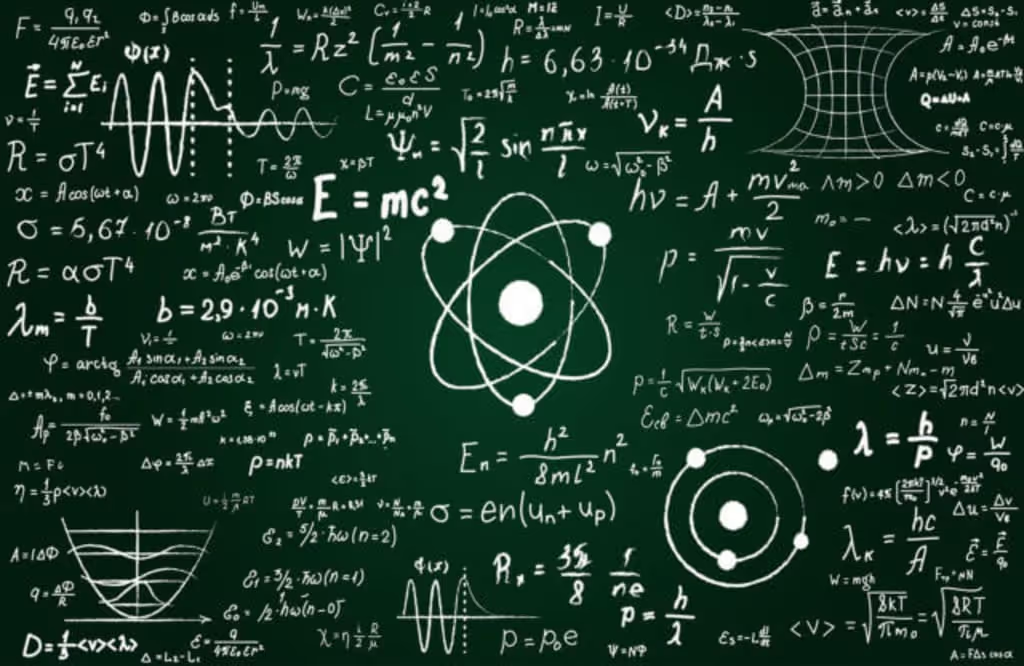
Physics can be challenging because students are expected to understand concepts, work with mathematical relationships and apply their knowledge to problems that may look different from the examples they have studied.
A student may understand one topic quickly but need considerably more time with another. One learner might benefit from diagrams and practical examples, while another may understand the same concept better by working through equations step by step.
This is where personalised learning can make a meaningful difference.
Rather than expecting every student to follow exactly the same learning path, personalised learning allows explanations, practice and support to respond to a student's existing understanding and specific areas of difficulty.
For students who need additional subject support, physics tutoring online can provide an environment where lessons can be adapted around individual learning needs.
What Is Personalised Learning in Physics?
Personalised learning means adapting the learning process to the student's current knowledge, difficulties, pace and goals.
In physics, this can be particularly useful because topics are often interconnected. A student who has gaps in one area may find later concepts harder to understand.
For example, difficulty understanding velocity and acceleration can make subsequent work involving forces and motion more challenging. Similarly, weaknesses in basic electrical concepts can affect a student's ability to approach more advanced circuit problems.
A personalised approach starts by identifying what the student already understands and where further explanation is needed.
Instead of spending equal amounts of time on every topic, a physics tutor can focus attention on the concepts that require the most work while continuing to reinforce areas the student already understands.
Why Do Students Learn Physics Differently?
There is no single method that works equally well for every physics student.
Some students understand a concept after seeing a worked example. Others may need a diagram, a real-world application or a series of simpler questions before the relationship becomes clear.
Students can also differ in how quickly they process mathematical information.
For example, one student might understand the physical concept but make mistakes when rearranging equations. Another might perform calculations accurately but struggle to determine which principle applies to a particular question.
These are different learning problems and may require different forms of support.
This is one reason physics tutors online can be useful. Individual sessions allow a tutor to spend more time investigating the specific point where a student is struggling instead of treating every learner as though they have the same difficulty.
Identifying Gaps in Physics Knowledge
Personalised learning begins with understanding what needs to be improved.
A student may know that they are “bad at physics” without knowing exactly why they are struggling. Breaking that problem down can reveal a much more specific issue.
For example, a student might struggle with:
- Understanding what a formula represents.
- Identifying the relevant information in a question.
- Choosing the correct equation.
- Rearranging equations.
- Converting units.
- Interpreting diagrams or graphs.
- Explaining the reasoning behind an answer.
- Applying a familiar concept to an unfamiliar problem.
Each of these difficulties requires a slightly different response.
An effective online physics tutor can work through questions with the student to identify recurring mistakes and determine which underlying concept needs further attention.
This is more useful than simply giving students additional questions without understanding why they are getting them wrong.
Adapting Explanations to the Student
One of the clearest benefits of personalised learning is that the explanation can change when the first explanation does not work.
Suppose a student is struggling to understand acceleration.
Repeating the same definition several times may not solve the problem. A different explanation might use a simple motion example, a graph, a visual representation and then a mathematical relationship.
Once the concept becomes clearer, the student can begin applying it to increasingly complex problems.
This does not mean that every student requires a completely different physics curriculum. The underlying subject knowledge remains the same.
Instead, personalised learning changes how the student is supported while learning that knowledge.
That distinction is important because effective tutoring is not simply about simplifying everything. Students should still be challenged appropriately as their understanding develops.
Learning at an Appropriate Pace
Another important part of personalised learning is pace.
Students can become frustrated when they are expected to move on before they have understood an important concept. At the same time, spending too long on material that a student already understands can make learning unnecessarily repetitive.
A personalised approach aims to find a productive balance.
During physics tutoring, a tutor can spend additional time on difficult concepts and move more efficiently through familiar material.
For example, if a student already understands basic energy transfers, a session does not necessarily need to spend most of its time revisiting those fundamentals. The available learning time may be better used on the area causing difficulty.
This can make revision more focused and purposeful.
Turning Mistakes Into Learning Opportunities
Mistakes are a normal part of learning physics.
The important question is not simply whether an answer is correct. It is understanding why an incorrect answer occurred.
A student may reach the wrong result because they:
- Selected an inappropriate equation.
- Misread the question.
- Used incorrect units.
- Made an arithmetic error.
- Misunderstood a physical relationship.
- Skipped an important step in their reasoning.
These errors provide useful information.
With individual support, a physics tutor can help a student identify the source of the mistake rather than simply correcting the final answer.
For example, if a student repeatedly uses the wrong equation, the underlying problem may be conceptual rather than mathematical. Helping the student recognise the conditions under which different equations apply can address the actual weakness.
This approach encourages students to become more aware of their own problem-solving process.
Personalised Learning and Problem-Solving
Physics requires more than remembering information.
Students must often take information from a question, identify the relevant physical principle and determine how that principle can be applied.
This becomes particularly important as questions become less familiar.
A personalised approach can gradually move students from guided examples towards independent problem-solving.
A tutor might initially work through a problem with the student, explaining each stage. The student can then attempt a similar question with some guidance before eventually solving a new problem independently.
This progression helps students develop a repeatable approach:
Understand the concept → identify the relevant information → choose a method → solve the problem → check the result.
The level of support can then be reduced as the student's confidence and independence increase.
Connecting Physics With Real-World Examples
Personalised learning can also involve connecting physics concepts to situations that are meaningful to the student.
Physics is present in everyday experiences.
For example:
- Forces can be explored through sport, transport and movement.
- Energy can be connected to household appliances and mechanical systems.
- Electricity can be related to circuits and electronic devices.
- Waves can be connected to sound, light and communication.
- Motion can be explored through vehicles and everyday movement.
A real-world example does not replace mathematical understanding. Instead, it can provide a context that helps students understand what an abstract concept represents.
The most useful example will depend on the student and the topic being taught.
The Role of Physics Tutoring Online
Physics tutoring online can support personalised learning by giving students access to focused, one-to-one subject support without requiring them to travel to a physical tutoring location.
Online sessions can be used to:
- Review difficult concepts.
- Work through specific questions.
- Practise calculations.
- Analyse recurring mistakes.
- Prepare for assessments.
- Revisit topics that were not fully understood in class.
- Develop independent problem-solving strategies.
Digital tools can also make it easier to share diagrams, equations, worked examples and other learning materials during a session.
However, the online format itself does not guarantee effective learning.
The quality of tutoring still depends on the tutor's subject knowledge, explanation skills, ability to identify misconceptions and ability to adapt the lesson to the student's needs.
Personalised Learning for GCSE and A Level Physics
Personalisation can be particularly relevant when students are preparing for major examinations.
GCSE and A Level physics require students to understand a broad range of concepts and apply them to different types of questions. Students may therefore have very different revision priorities.
One student may need additional work on mechanics, while another may need support with electricity, waves or mathematical problem-solving.
Rather than spending revision time equally across every topic, students can use targeted practice to focus on areas where they have identified weaknesses.
Physics tutors can support this process by helping students review difficult topics, practise exam-style questions and understand the reasoning behind their mistakes.
The exact priorities should depend on the student's course, examination requirements, current understanding and assessment goals.
Building Confidence Through Individual Progress
Personalised learning can also affect how students approach difficult subjects.
When students repeatedly encounter the same type of problem without understanding it, they may begin to associate physics with failure. Identifying a specific weakness and making measurable progress can create a different learning experience.
For example, a student who previously struggled to solve force questions may become more confident after learning how to identify the relevant quantities, select an equation and check the final result independently.
The confidence comes from being able to demonstrate progress.
This is an important distinction. Effective tutoring should not simply tell students that they can succeed. It should help them develop the knowledge and skills that allow them to see their own improvement.
What Makes Personalised Physics Tutoring Effective?
Personalised tutoring works best when the support remains focused on the student's actual learning needs.
Useful characteristics can include:
- Clear explanations of difficult concepts.
- Questions that encourage students to explain their reasoning.
- Practice matched to the student's current level.
- Feedback that identifies the source of mistakes.
- Opportunities to revisit difficult topics.
- Gradually increasing problem difficulty.
- Encouragement of independent thinking.
- Regular review of progress.
The tutor should not simply provide solutions whenever a student gets stuck.
Instead, students should be encouraged to think through the problem, explain their approach and develop strategies that they can eventually use without assistance.
This helps turn tutoring from answer-provision into skill development.
How Personalised Learning Can Change the Physics Experience?
Physics can feel very different when students understand why they are doing something rather than simply being told what to memorise.
A personalised approach can help students identify their individual gaps, receive explanations suited to those gaps and practise concepts at an appropriate level.
For students using physics tutoring online, this can create a more focused learning experience where sessions are built around specific needs rather than a generic sequence of topics.
The objective is not to remove every challenge from physics. Challenge is an important part of learning the subject.
Instead, personalised learning can help ensure that students are challenged at an appropriate level while receiving enough explanation and support to make progress.
Conclusion
Personalised learning can transform the way students approach physics by shifting the focus from simply covering content to understanding how each student learns that content.
When students receive support based on their existing knowledge, individual difficulties and learning pace, they can spend more time addressing genuine gaps and developing the skills needed to solve problems independently.
Physics tutoring online can provide one way to deliver this type of focused support, particularly for students who need additional explanation, targeted practice or structured exam preparation.
Ultimately, the goal of personalised physics learning is not simply to help a student answer today's question correctly. It is to help them understand the concepts, recognise how those concepts apply to new situations and gradually become more confident in solving problems independently.